




How Conversation Intelligence Helps Sales Teams Identify Buyer Intent



A sales rep finishes a call confident that the deal is moving forward. The manager listens to the recording and hears deep hesitation.
That gap isn't rare. Reps running compressed, back-to-back calls track the conversation while formulating the next questions, which is why polite, non-committal language like "that's interesting" gets misinterpreted as a buying signal.
Meanwhile, managers lack the time to review every call, and a quiet objection or a shift in the buyer's tone gets missed entirely. By the time the forecast is built, it reflects the rep's optimism, not the buyer's intent signals in sales calls.
Conversation intelligence for buyer intent changes what gets captured. Rather than relying on rep memory, it tracks keywords, competitor mentions, sentiment shifts, and talk patterns across calls, automatically flagging what moved a deal forward and what put it at risk.
Key Takeaways
- Buyer intent is revealed through both what buyers say and how they engage. Signals such as pain points, competitor mentions, stakeholder discussions, buying timelines, objections, and next-step conversations help sales teams understand a prospect's readiness to move forward.
- Even experienced reps miss intent signals in live conversations. Balancing discovery, note-taking, objection handling, and relationship building makes it difficult to consistently recognize every buying cue as it happens.
- Conversation intelligence helps teams identify, act on, and coach around buyer intent at scale. By analyzing customer conversations across the sales cycle, AI surfaces critical buying signals, enables targeted coaching, and helps revenue teams improve deal execution and forecasting accuracy.
What buyer intent actually sounds like on a sales call
Broadly, buyer intent signals fall into two categories: explicit signals and implicit signals.
Explicit signals: What buyers say
Explicit signals are the clearest indicators of buying intent because they're communicated directly by the buyer.
When a prospect starts discussing budget, implementation timelines, or business priorities, they're revealing qualification signals commonly organized through frameworks such as BANT.
For example:
-
"We've set aside budget for this initiative next quarter."
-
"Leadership wants a solution in place before our busy season."
-
"This project is one of our top priorities for the second half of the year."
These statements tell a sales rep that the conversation has moved beyond casual exploration and into active evaluation.
📌 "Perhaps the strongest intent signals come from discussions around decision-making. Questions about procurement, legal reviews, stakeholder involvement, and approval processes indicate that the buyer is already thinking about how to get a deal across the finish line."
Implicit signals: What buyers reveal through behavior
Not all intent is spoken aloud. Some of the most valuable signals appear in how buyers engage during the conversation.
For instance, when a prospect begins repeating your value proposition in their own words, they're demonstrating understanding and internalizing the business case. That's often a sign they're already envisioning how the solution fits into their organization.
Changes in sentiment can be equally important. A buyer who is highly engaged throughout a discovery conversation but suddenly becomes cautious during pricing discussions may be signaling an objection that hasn't yet been verbalized.
Even silence can be informative. If a buyer becomes noticeably quiet after hearing implementation requirements, pricing details, or contract terms, that pause often indicates they're processing concerns, evaluating risk, or encountering internal resistance.
These moments are easy to miss in real-time. Yet they frequently reveal more about deal health than the buyer's words alone.
| Signal category | Examples |
|---|---|
| Explicit signals | Budget discussions, implementation timelines, business priorities, pain points, competitor comparisons, procurement questions, stakeholder involvement, decision-making process discussions |
| Implicit signals | Buyer repeating value propositions in their own words, increased engagement, sentiment shifts, concern or hesitation after pricing discussions, urgency in questioning, references to internal discussions, requests for next steps |
| Conversation intelligence metrics | Talk-to-listen ratio, question frequency, interruption patterns, speaker engagement, sentiment trends, keyword frequency, topic recurrence |
Why reps miss buyer intent signals in live conversations
According to Mindtickle's 2026 State of Agentic Revenue Enablement Report, discovery call length has dropped from 36 minutes in 2024 to 30 minutes in 2025. Now imagine if reps dominate the conversation, buyers have fewer opportunities to reveal their priorities, challenges, and decision criteria.
The problem often starts before the call. Without sufficient research, reps rely on generic qualification questions that generate generic answers. Critical intent signals around urgency, business impact, and buying readiness never surface.
Even when they do, they're easy to miss. During discovery calls, reps are listening, taking notes, building rapport, handling objections, and planning their next question at the same time. A competitor mention, budget reference, or comment about internal approvals can quickly pass by unnoticed.
The risk grows in later-stage conversations. Reps focused on advancing the deal may overlook hesitation around pricing, implementation, or contract terms — signals that often point to unresolved concerns.
Buyer intent is rarely communicated through a single statement. It emerges through a combination of comments, questions, and behavioral cues that unfold throughout the conversation, making it difficult to consistently identify and act on in real-time.
💡 Do you know
Studies have shown conversation intelligence can drive at least a 64% increase in revenue generated by reps in their first quarter and a 50% average reduction in ramp-up time for new hires.
➕Bonus Read: 6 Ways to Have More Productive Sales Calls
How conversation intelligence surfaces intent across the sales cycle
Buyer intent isn't a single moment. It develops throughout the sales cycle as prospects move from exploring a problem to evaluating solutions and making a purchase decision.
The challenge is that these signals are rarely obvious. They emerge through comments, questions, objections, stakeholder discussions, and buying cues scattered across multiple conversations. Capturing and interpreting them consistently is difficult for even the most experienced sellers. That's where conversation intelligence helps.
Pre-qualification: Identifying potential opportunities
In early conversations, buyers rarely discuss products. Instead, they talk about business priorities, growth initiatives, operational challenges, or strategic goals.
Conversation intelligence helps surface these themes automatically, giving reps a clearer understanding of whether a prospect has a problem worth solving and an initiative worth pursuing.
Discovery: Understanding urgency and business impact
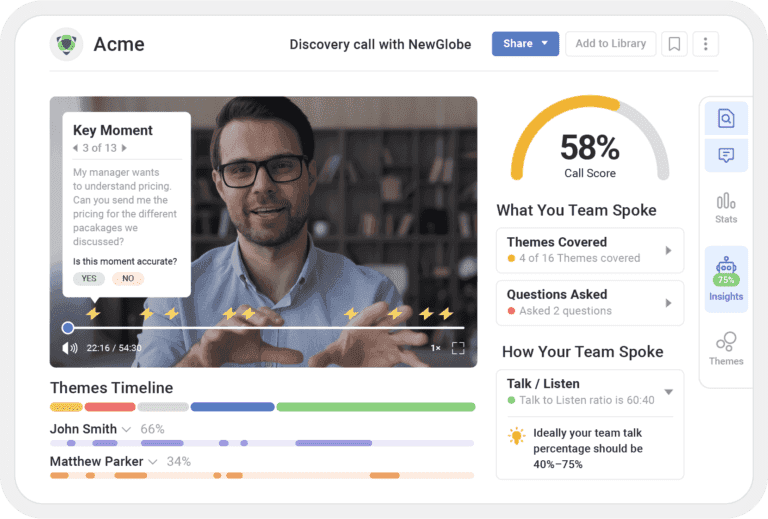
Discovery is where intent becomes easier to spot. Buyers begin discussing challenges, desired outcomes, existing processes, and the consequences of inaction. Conversation Intelligence solutions can identify recurring pain points, business-impact discussions, and engagement patterns that indicate whether the problem is significant enough to drive a purchasing decision.
👆Share Now: The Discovery Call Playbook
Evaluation: Tracking buying signals
As buyers compare solutions, conversations shift toward capabilities, differentiation, proof points, and competitive alternatives. Mentions of competitors, requests for customer references, stakeholder participation, and discussions about requirements often signal that the opportunity is advancing. Conversation intelligence surfaces these signals automatically, helping reps understand where buyers are in their evaluation process.
Negotiation: Uncovering hidden concerns
By the negotiation stage, intent is usually established. The focus shifts to identifying risks that could slow or derail the deal. Questions about pricing, implementation, contracts, security reviews, or deployment timelines often reveal concerns that need attention. AI helps sales teams identify recurring objections and discussion patterns so they can address issues before they become deal blockers.
Purchase: Confirming buying readiness
In the final stage, conversations typically revolve around procurement, legal approvals, implementation planning, and stakeholder alignment. These discussions provide strong indicators that buyers are preparing to move forward. Conversation intelligence helps reps and managers track these signals, ensuring opportunities continue progressing toward a successful close.
✌️ Two Cents from Mindtickle
Every customer conversation is a source of market intelligence. Beyond helping reps understand buyer intent, conversation intelligence reveals the questions prospects ask most often, the objections they raise, and the messages that resonate. These insights can help sales, marketing, and product teams refine their positioning based on real customer conversations.
Also Read: How To Choose A Conversation Intelligence Platform
Turning buyer intent into a repeatable coaching system
Buyer intent signals are present in nearly every sales conversation. The challenge is to recognize them consistently and turn them into meaningful action.
That's where conversation intelligence creates value. By automatically capturing and analyzing customer conversations, it helps sales teams identify buying signals that would otherwise be missed, from emerging pain points and competitor mentions to stakeholder involvement and purchase readiness.
But identifying intent is only the first step.
Mindtickle's Conversation Intelligence platform connects conversation insights directly to rep development and deal execution. When a competitor mention is mishandled, reps can be guided to targeted coaching and practice. When buying signals indicate a deal is at risk, managers gain visibility into where intervention is needed. And when top performers demonstrate effective behaviors, those moments can be shared and scaled across the team.
The result is more than better call analysis. It's a repeatable system for helping reps recognize buyer intent, respond effectively, and improve with every customer interaction.
Gain skill & deal insights with conversation intelligence
Frequently Asked Questions
About the Author
Senior Content Manager
Ruchi Madan leads content marketing at Mindtickle. She has spent her career in enterprise SaaS, building content programs that span product, demand, and customer marketing.
Her work sits at the intersection of brand and pipeline, producing content that demand gen teams can use and that moves buyers through the funnel. She directs external agencies and freelancers, sets editorial standards, and works closely with product marketing and sales enablement to keep messaging consistent across campaigns and channels.

Subscribe to the blog
Get the latest sales enablement tips, guides, and industry best practices delivered to your inbox. Unsubscribe anytime.